
Insights

One Investment. Actively Managed Growth.

UiPath – Charting the Path Towards Enterprise Automation

LinkedIn
Twitter
Facebook
Email

AuthorEvan Dawe

NYSE: PATH – $16.88 per share as of market close on January 8th
UiPath $PATH is a leading provider of AI-powered enterprise automation software. The company combines traditional Robotic Process Automation (RPA) with agentic AI to automate business processes. UiPath is best known for its RPA, which is used to automate tedious, rules-based tasks like data entry, filling out forms, KYC, or other repetitive processes that humans often do manually. The benefit of RPA is that it works on top of existing IT systems as an execution layer without requiring an overhaul.
 
UiPath is the dominant player in the RPA in the market with an estimated 57% market share, which is higher than Microsoft in second place at 17%. Since the company was founded in 2005, it has built an impressive customer base of 10,860 subscribing customers, including two thirds of the Fortune 500.

Challenges Since the 2021 IPO – UiPath’s Underperformance

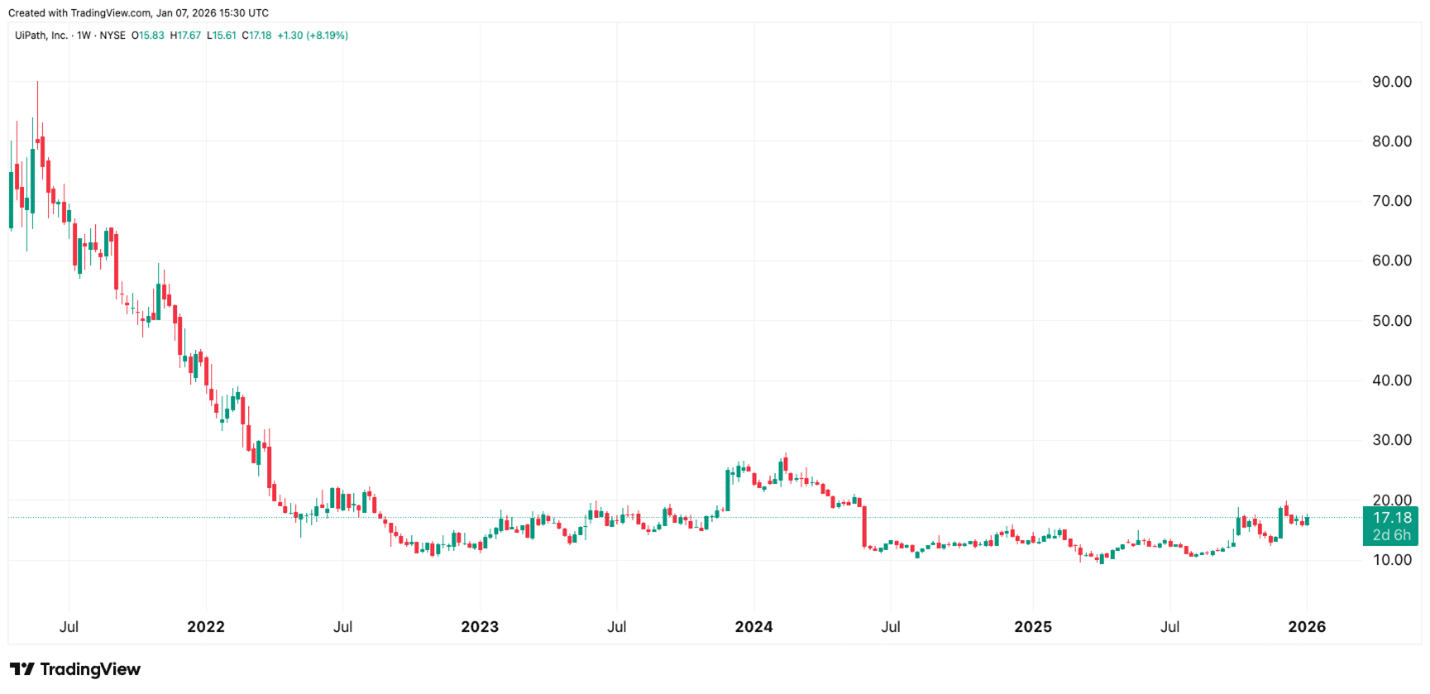
To understand the opportunity for UiPath today, it helps to understand how it got here. UiPath currently trades about 75% below its 2021 IPO price due to the following reasons:
 
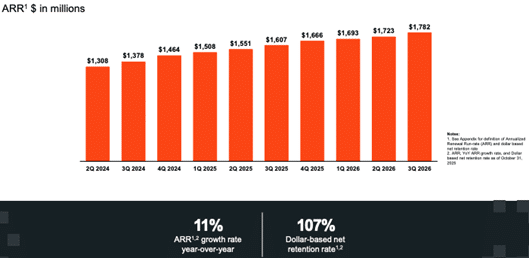
  1. Top line growth rates slowed significantly since going public. ARR growth decelerated from 65% in Q1 FY2022 to 11% year over year during the Q3 FY2026 quarter.
  2. Competition intensified in the RPA market. Major tech companies such as Microsoft and Salesforce offering similar automation tools, creating pressure on margins.
  3. The rapid emergence of AI and LLMs created angst amongst investors that RPA could be disrupted and become obsolete. This narrative weighed on investor sentiment and caused significant volatility and valuation multiple compression in UiPath’s stock.
A Shifting Narrative – The Early Phase of a Turnaround
 
Key performance and financial metrics have stabilized or improved in recent quarters and a potential turnaround at UiPath appears imminent. The narrative that RPA is dying is also beginning to flip. UiPath’s CEO Daniel Dines has frequently claimed that AI will increase demand and usage of RPA software, enabling it to move beyond automating rules-based tasks into complex, high-value processes across entire enterprises. In a recent CNBC interview, Daniel Dines stated:
 
“We are in the early innings of deployment of agentic AI, we see a very solid demand. I can think that, you know, since the early days of RPA, I have not seen such a huge interest from customers in a renewed automation initiative interest”
 
Rather than disrupting RPA, the rise of AI agents appears to be accelerating its adoption. The improving SaaS metrics and financial data from UiPath’s recent Q3 FY2026 earnings support this claim.
 
Reaching an Inflection Point
 
UiPath’s SAAS metrics show that customer usage continues to expand and is beginning to accelerate again, bucking the trend of de-acceleration over the last few years.
 
  1. Dollar based Net Retention Ratio (NRR) remains expansionary at 107%, indicating that existing customers are increasing spend. Notably, the NRR on contracts between $100,000 and $1 million was 113%, indicating that the larger contracts are outperforming the lower end of the market.
  2. Customer related metrics are rebounding: Total customers reached 10,860 (up 12% year-over-year), and the gross retention ratio was 98%, demonstrating customer stickiness. Net new ARR has trended upwards sequentially during the first three quarters of FY2026, and Q4 guidance suggests further growth is anticipated. This indicates that sales execution and product demand are strengthening.
  3. Q3 FY2026 delivered beats over analyst consensus on Revenue and EPS, and management issued strong guidance for Q4. It was the first profitable Q3 for UiPath in its history, and the company signalled it is on track for a full fiscal year of GAAP profitability.
  4. Several key partnerships were announced in 2025, including with OpenAI, Microsoft, Google, Snowflake, and Nvidia, providing strong validation of UiPath within the enterprise AI stack.
Maestro – The Key to Growth Acceleration

 
Maestro, UiPath’s new orchestration layer launched in 2025, combines the benefits of deterministic and probabilistic automation in one powerful enterprise platform.
 
Traditional RPA (Deterministic) excels at repetitive rules-based tasks where precision is important. The downside is that it is rigid and it struggles with unstructured data where exceptions may be required.
 
In essence, probabilistic automation (LLMs and AI) handles uncertainty with decision making via probabilities including in complex scenarios. On the negative side, errors and hallucinations can be common with probabilistic automation and it is often unreliable for high precision use cases without human oversight.
 
Maestro uniquely combines both, coordinating RPA bots (deterministic execution), AI agents (LLMs for probabilistic reasoning), APIs, and human interactions to automate workflows. Previously, UiPath was limited to automating repetitive, tedious processes. With the launch of Maestro, UiPath is capable of automating enterprise-wide processes across a much broader spectrum of work.
 
Having a majority of the Fortune 500 as customers for its legacy RPA products, the upsell opportunity for Maestro is significant. Initial customer feedback on the product has been positive, reinforcing the potential for UiPath to deliver significantly higher revenue growth rates.


The pricing structure of Maestro has not yet been disclosed, but Daniel Dines has stated that they are exploring outcome-based pricing, consistent with the approach taken by Palantir. This is a strong indicator of confidence in the product’s potential.

The kicker is that revenue from Maestro has not been included in managements guidance for FY2026, and guidance has not yet been provided for FY2027 (calendar year 2026). Updated guidance for FY2027 that includes Maestro revenue will come with the Q4 FY2026 earnings print in March, and depending on product traction, offers a potential positive catalyst. 
 

Customer Use Cases

To provide an idea of the real-world impact Maestro is delivering, here are a few standout examples that were discussed on the Q3 earnings call:

  1. USI insurance, one of the largest Insurance brokerages in the world uses Maestro to process incoming requests and generate output. “USI expects over $32 million in savings over the next 3 years.” – Daniel Dines on the Q3 earnings call.
  2. One of the world’s largest investment management firms is also a Maestro client, integrating it with ServiceNow, Confluence and specialized LLMs to orchestrate end-to-end workflows. Maestro has delivered a “95% reduction in time to value and tens of millions in projected savings” according to Dines.
  3. Other customer use cases discussed on the earnings call include the U.S. Federal Government, Corewell Health, Energie, and the U.S. Coast Guard.

The industries mentioned (insurance, financial services, healthcare, and government) are among the largest industries in the world. Even if UiPath can rollout Maestro among its existing customer base, the revenue growth potential is huge.

Valuation – Asymmetric Risk/Reward Characteristics

UiPath trades at a forward non-GAAP P/E of 25x, P/CFO of 24x, and an ARR multiple of 5x.

For a growing and profitable software firm with strong tailwinds from AI, these multiples appear undervalued relative to peers such as Snowflake, Palantir, ServiceNow, and Appian. The balance sheet is clean, with 1.4B in cash and equivalents and no material debt. In my opinion, the current share price and fundamentals provide a significant margin of safety, limiting the downside if growth does not accelerate as forecasted. After studying the impact that AI is having on the business and the product roadmap, I am confident that UiPath’s accelerating top line growth could surprise the market in 2026, triggering a significant rerate in the valuation and share price. The market still seems to be pricing UiPath like it is an aging RPA business and has not yet fully reflected the agentic AI / Maestro opportunity.

Founder Led Company

When analyzing any company, the management team is one of the most critical factors to assess. UIPath scores highly with its founder & CEO, Daniel Dines. Dines is a Romanian software engineer with a master’s degree in mathematics and computer science from the University of Bucharest. He began working at Microsoft in Seattle from 2001- 2005 before leaving to start his own company, DeskOver, which eventually renamed to UiPath. Since founding the company 20 years ago, Daniel has grown UiPath from humble beginnings in Bucharest to the $9B company that it is today.

Daniel Dines briefly stepped aside in January 2024 and Rob Enslin was appointed CEO. This was a turbulent time for UiPath as it faced declining growth rates, competitive pressures, and threats from AI. During Rob Enslins brief term as CEO, UiPath reported weakening quarterly results that missed guidance estimates, with management citing a longer sales cycle and lower average deal sizes. Investors grew increasingly concerned about the future of UiPath, Rob Enslin resigned, and Dines returned as CEO in June 2024 with a renewed focus on profitable growth, and product innovation.

After watching hours of his interviews, presentations, and earnings calls, I have confidence in Daniel as a CEO to keep the company on the right track and deliver strong shareholder returns.

Daniel Dines - Founder and CEO of UiPath

Daniel Dines – Founder and CEO of UiPath

Concerns and Risks
 
High Share Based Compensation (SBC): At $358M in FY 2025 and $313M in the trailing twelve months, SBC has been higher than I would prefer to see, but it has been trending downwards in recent quarters. On the bright side, total share count has been declining due to UiPath’s large stock repurchases. In FY 2025, UiPath bought back $390M worth of stock, more than offsetting the SBC issuances. I would like to see SBC moderate, but for now it isn’t a deal breaker.
 
Potential disruption from AI: The possibility that AI and LLMs could diminish the need for RPA is the bear argument that has impacted UiPath for the last couple years and is the crux of the divergence of investor opinions on this stock. While there are signs of turnaround happening, nothing is certain. UiPath’s new agentic AI offerings and Maestro look promising, but they are new products that have not fully proven product market fit. If Maestro under-delivers against expectations, further downside is possible.
 
Competition is a key concern in the RPA business and amongst AI software providers. Companies such as Microsoft and Automation Anywhere have competing RPA products and vast customer bases. Other AI native solutions such as Palantir and OpenAI could present risks if they entered the RPA and orchestration markets. That said, UiPath’s software acts as a layer on top of existing enterprise software and often integrates with it rather than replacing it. UiPath’s partnerships with OpenAI, Nvidia, Google, Microsoft, and Snowflake show that UiPath is often complimentary to, not necessarily competitive with, existing solutions.
 
The risks are manageable, and the valuation prices in a healthy dose of skepticism.
 
Final Thoughts
 
The market has taken a ‘wait and see’ approach to UiPath, yet evidence is mounting that a turnaround is imminent; dollar based NRR has stabilized, gross retention ratio is strong, revenue has accelerated for three straight quarters, and the company recently turned profitable.
 
Maestro provides upside optionality as a potential large-scale growth driver that isn’t reflected in the current valuation. If the product is as effective as early reports indicate, guidance from management in the coming quarters could catch the market by surprise and spark a re-rating.
 
I am confident that UiPath is well positioned to be a strong out-performer in 2026.

DISCLAIMER
* Not financial advice, do your own research. Torrent is long shares of PATH through shares and/or options. This article expresses the author’s own opinions and there is no business relationship with any company whose stock is mentioned in this article. No recommendation or advice is being given as to whether any investment is suitable for a particular investor.

Search Insights

Latest Insights

Keep in Touch

Newsletter

Subscribe here to have our up-to-date news and market insights delivered to your inbox.